I run six machines at home: a Proxmox host, three Linux VMs, a Synology NAS and the Windows PC I work on. I wanted one place that answers a simple question every morning: is anything I run affected by a known vulnerability, and is there a fix? So I added a Security tab to my homelab portal. It reports only. It never patches anything.
The short version
Every night the portal collects what is installed on each machine, matches it against public vulnerability data, and shows the result per machine. Findings that are actively exploited, or critical with a fix available, raise an alert like any other incident in the portal.
Three kinds of machine, three ways to match
The hard part was that "installed software" means something different on each box.
- Debian and Ubuntu hosts. The portal reads the package list over a locked-down SSH key and asks OSV.dev which packages have advisories. OSV returns the fixed version too, so each finding says what to upgrade to.
- The Windows PC. There is no package ecosystem to query. The PC pushes its app list once a day, and the portal maps each app name to a product in the National Vulnerability Database (NVD), then checks the installed version against each CVE's affected range. Weak name matches are refused, because a wrong match is worse than a missing one.
- The Synology NAS. DSM is not a package list either, but the NVD tracks it as a product. A forced SSH command on the NAS returns only its version file, and a cron job on an always-on machine pushes it. The NAS cannot run anything else through that key.
Exploited-in-the-wild status comes from the CISA Known Exploited Vulnerabilities catalog.
What went wrong along the way
Version numbers bit me twice. DSM versions look like 7.2.1-69057-13, but the NVD writes ranges like 7.2-64570-4. Compared naively, my up to date NAS looked vulnerable to everything. The fix was to read the part before the dash as a three number release and the rest as build and update.
The second lesson was about noise. A lot of Debian findings come back with no severity at all, because OSV does not rate them. Most of those are also unrated upstream, so the Debian security tracker can only rate some of them. I pull its urgency where it exists and leave the rest as unrated rather than guess. Alerts only count findings that have a fix available, so an unrated pile does not page me.
Before and after
The first real scan was alarming. The central server showed 37 known exploited findings and 141 critical ones.
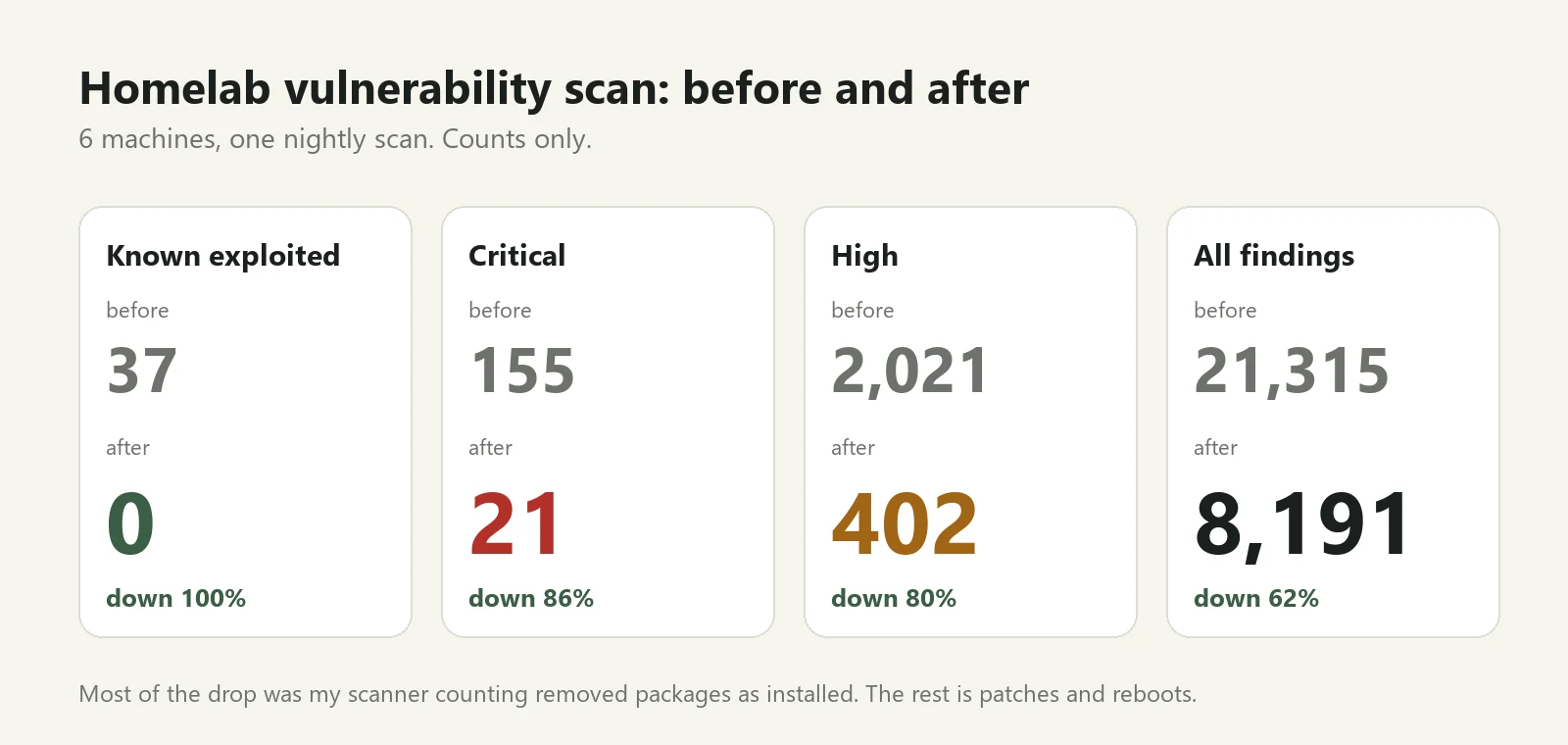
Most of it was my scanner's mistake, not the server's. Debian and Ubuntu keep a record of a removed package's leftover config files (state rc), and my script listed those as installed. Twelve old kernels I had removed long ago were being scanned as if they were running, about 900 findings each. The fix was one filter: only count packages whose state is installed.
I then patched the three VMs and the Proxmox host, rebooted them, and rescanned.
Central went from 37 known exploited and 141 critical to 1 and 7, and nothing on it has a fix waiting. What remains is mostly kernel CVEs that Ubuntu has not fixed yet, so there is nothing to apply. The last exploited finding was a WebKit library that Ubuntu had not patched, pulled in by the desktop metapackage on a server that never opens a browser. I removed the metapackage and the WebKit libraries, and the next scan showed zero known exploited findings on every machine.
The Windows PC had a Terraform finding that turned out to be a false positive: the CVE is for Terraform Enterprise, whose version scheme never compares with the command line tool. I had written an override for it, but a stray comment on the same line swallowed it, which is how it kept showing up. The PC's Python findings are real, and the fix is a newer Python.
The NAS is clean.
Design choices I would keep
- Report only. Patching is a separate decision with a snapshot first, and some hosts should stay manual.
- A machine that is off is skipped, never failed. My PC is often asleep at scan time.
- Network calls never happen inside a database write, because SQLite has one writer and the web pages need it.
- One alert per machine, not one per CVE.
The portal runs on FastAPI with SQLite.
What is next
Possibly a one click, approved update for the two apt VMs, with a snapshot first. The Proxmox host, the NAS and the central server stay manual.
The bigger idea is a SIEM lite. This page answers "what is vulnerable". A SIEM answers "what is happening", so the next step is shipping SSH and auth logs, Docker logs and Caddy access logs from every machine into the portal, with a few correlation rules on top: failed logins followed by a success, a new SSH key appearing, or a host with an exploited vulnerability making odd outbound connections. I will compare it against Wazuh before building anything, and write that up as its own note.